

Discover the essential stages of a fleet RV repair workflow. Ensure efficient maintenance and minimize downtime with our practical guide.
TL;DR:
- A fleet RV repair workflow consists of five critical stages: defect identification, triage, scheduling, technician execution, and close-out, which must be followed without skipping to prevent downtime. Digital tools like Fleet Rabbit and Fleetio streamline these stages by automating data flow, verifying compliance, and enhancing communication to boost efficiency and safety. Discipline in workflow management, combined with proactive communication and proper software, significantly improves fleet uptime and regulatory adherence.
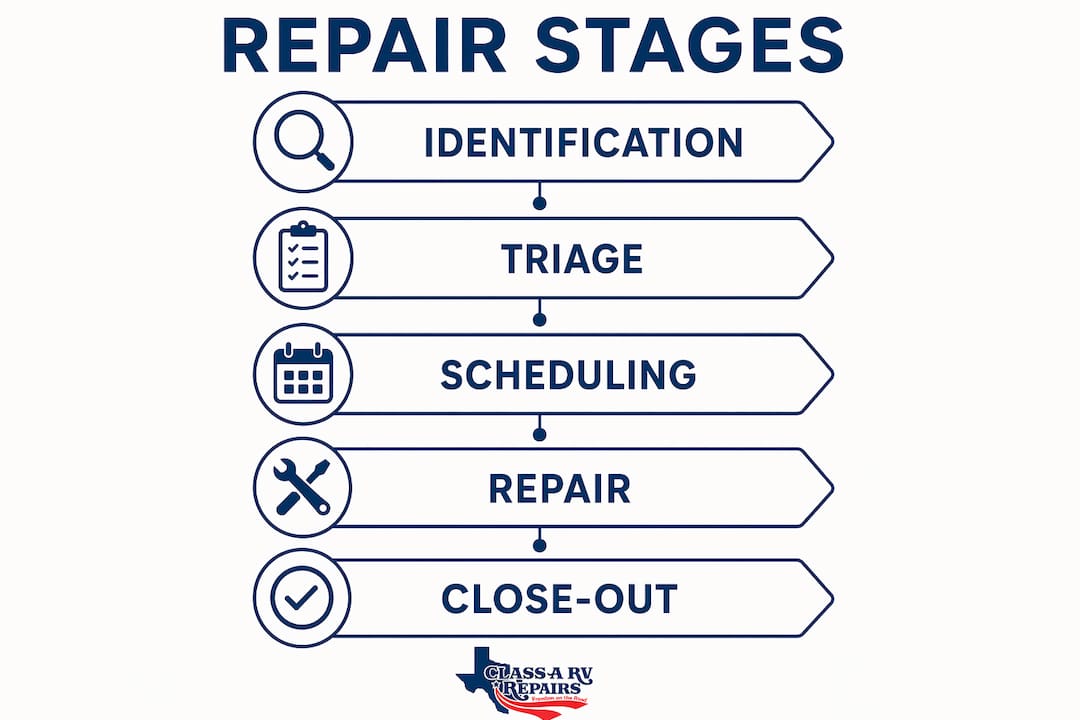
A fleet RV repair workflow is a five-stage process that transforms scattered repair requests into audit-ready maintenance cycles, covering defect identification, triage, scheduling, technician execution, and close-out. Fleet managers who skip even one stage face workflow collapse and cascading downtime. Tools like Fleet Rabbit and Fleetio have made digital execution of this pipeline practical for fleets of any size. In Central Texas, where summer heat and Hill Country roads accelerate wear on motorhomes and travel trailers, a disciplined RV fleet maintenance process is the difference between a vehicle on the road and one sitting in a bay for two weeks.
What are the five essential stages of a fleet RV repair workflow?
The industry term for this process is a fleet maintenance pipeline, and each stage serves a specific gate-keeping function. Skipping any stage causes handoff friction that multiplies repair cycle times and raises the risk of unsafe dispatch.
- Defect identification. Intake sources include driver DVIR (Driver Vehicle Inspection Report) submissions, telematics fault codes, preventive maintenance triggers, and roadside events. The goal is capturing enough detail at intake to prevent follow-up calls that stall the next stage.
- Triage. A service writer or shop foreman reviews each defect report and assigns severity and urgency. A blown tire on a coach in active service ranks above a cosmetic scratch on a unit in storage. Without formal triage, every repair feels equally urgent and nothing gets prioritized correctly.
- Scheduling. Bay-hours, technician availability, and parts lead times all factor into this stage. A roof inspection that blocks a bay for six hours requires different capacity planning than a brake adjustment. Bay-hours planning and early disclosure of parts lead times prevent the scheduling disruptions that push jobs past customer trip dates.
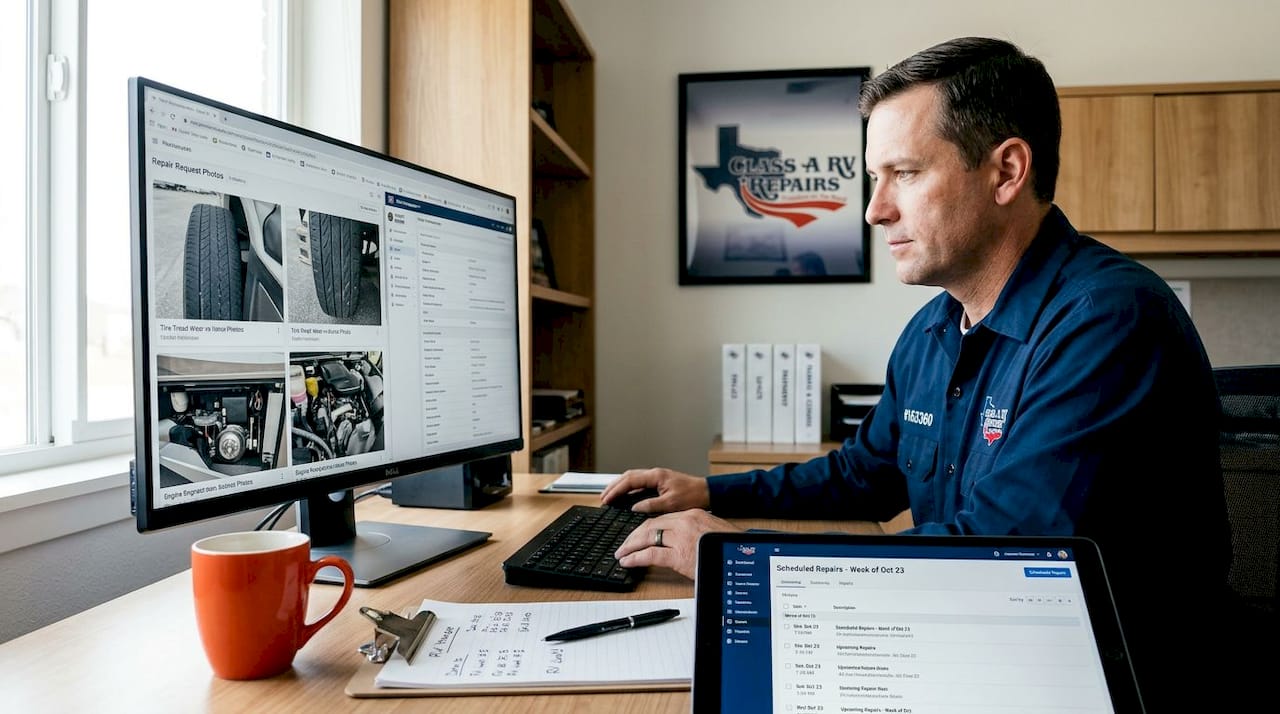
- Technician execution. The assigned technician receives a complete work order on a mobile device, including defect photos, parts status, and prior service history. First-time fix rates above 90% are achievable when technicians have full context before they pick up a tool. Incomplete job packets are the single biggest driver of repeat repairs.
- Close-out documentation. The repair record is certified, the FMCSA-required signatures are collected, and the vehicle is cleared for dispatch. No unit returns to service without a completed chain-of-custody closure.
Pro Tip: Set a rule that no work order advances to scheduling without a photo attached at intake. This one habit eliminates most of the “I need more information” delays that stall triage.
| Stage | Primary function | Key failure point |
|---|---|---|
| Defect identification | Capture complete defect data at intake | Vague reports requiring follow-up calls |
| Triage | Assign severity and urgency | No prioritization system, all jobs treated equally |
| Scheduling | Align bay-hours, parts, and technician | Parts ETA ignored until job is already booked |
| Technician execution | Execute repair with full context | Incomplete work orders causing repeat visits |
| Close-out | Certify repair and clear for dispatch | Missing signatures blocking compliance audit |
How to optimize scheduling, parts management, and technician workflow
Scheduling is where most fleet RV inspection workflows break down in practice. The problem is not a lack of appointments. It is a failure to model physical constraints against actual demand.
- Model bay-hours, not just time slots. A roof repair on a 40-foot Class A motorhome physically blocks a bay for the full duration, regardless of how many labor hours the job requires. Booking two roof jobs back-to-back on the same bay is a scheduling error that compounds into a full-day delay.
- Anchor parts ETA alarms to trip dates. Parts escalation triggers should fire when a parts ETA pushes within seven days of a customer’s departure date, not when a calendar deadline passes. At that point, you offer rush shipping, a temporary fix, or a hold with a rescheduled appointment.
- Know what mobile techs can and cannot do. Mobile RV repair management works well for electrical diagnostics, minor slide-out adjustments, and fluid services. It does not work for collision repair, fiberglass work, or anything requiring a lift. Sending a mobile tech to a job that needs a shop bay wastes a dispatch and frustrates the customer.
- Communicate early and specifically. Silence is the fastest way to lose a customer’s trust. If a parts order is delayed, call before the customer calls you. Give a specific date, not a range.
- Use off-season marketing to fill slow months. In Central Texas, the shoulder seasons between spring and fall travel peaks are predictable. Proactive outreach for preventive maintenance appointments during those windows keeps bays productive and reduces the spring rush backlog.
Pro Tip: Build a preventative maintenance schedule for each unit in your fleet and tie it to mileage and season, not just calendar dates. This converts reactive fire-fighting into planned throughput.
What compliance requirements shape fleet RV repair workflows in 2026?
FMCSA regulation 49 CFR 396.11 defines the legal framework for commercial vehicle defect reporting and repair certification. The three-signature cycle it mandates is not optional, and incomplete compliance creates both legal exposure and operational risk.
The three required signatures are:
- Driver reporting the defect on a pre-trip or post-trip DVIR
- Mechanic certifying that the defect was repaired or that no repair was necessary
- Next driver acknowledging the repair record before operating the vehicle
Compliance workflows convert legal documentation from a paper chore into a real operational gate, preventing unsafe dispatch. A vehicle cannot legally return to service until all three signatures are on record.
Digital DVIR software like Fleet Rabbit locks vehicle dispatch until the next driver reviews and signs the prior repair record. This removes the human error of a dispatcher releasing a unit before the compliance chain is closed. Paper-based systems fail this gate constantly because the paperwork is physically separate from the dispatch decision.
Repair close-out documentation also serves as your audit defense. FMCSA inspectors look for a complete chain of custody from defect report to certified repair to driver acknowledgment. Gaps in that chain result in out-of-service orders and fines that dwarf the cost of any software subscription.
How can digital tools improve fleet RV repair workflows and communication?
Software platforms purpose-built for fleet maintenance, including Fleet Rabbit and Fleetio, address the handoff friction that drives most maintenance failures. The core value is not automation for its own sake. It is the elimination of the phone calls, paper shuffling, and status-check interruptions that consume shop time without producing repairs.
| Manual workflow | Digital workflow |
|---|---|
| Driver calls in defect verbally | Driver submits DVIR with photos via mobile app |
| Service writer creates work order manually | Work order auto-generated from DVIR submission |
| Parts status checked by phone | Real-time parts tracking with ETA alerts |
| Technician receives paper job packet | Technician receives full digital work order on mobile device |
| Close-out signed on paper, filed in binder | Digital signatures archived in cloud, audit-ready instantly |
Fleetio’s documented customer cases show that reactive invoice reconciliation was replaced with digital repair order submissions requiring pre-approval, cutting both cost overruns and administrative back-and-forth. For multi-unit fleets, that upstream cost control compounds quickly across a season.
Pro Tip: Choose software with offline capability. In the Texas Hill Country, cellular coverage is inconsistent. A mobile tech who loses connectivity mid-job should not lose their work order data.
What common workflow pitfalls should fleet managers avoid?
Most fleet maintenance failures trace back to workflow breakdowns, not mechanical failures. Recognizing the patterns before they become habits is the fastest way to protect uptime.
- Paper DVIRs and manual triage introduce delays at the first two stages. A defect report sitting in a clipboard stack is not being triaged. Digital intake eliminates the lag between report and response.
- Ignoring parts lead times at booking is the most common scheduling error. Booking a job without confirming parts availability guarantees a mid-repair stall and a frustrated customer.
- Broken compliance chains expose your fleet to FMCSA fines and out-of-service orders. One missing signature on a DVIR is enough to trigger a violation during a roadside inspection.
- Incomplete technician context forces mechanics to diagnose from memory or make assumptions. A work order without photos, prior repair history, or confirmed parts status produces guesswork, not repairs.
- No customer communication protocol turns every parts delay into a complaint. Set a rule: any delay beyond 48 hours gets a proactive call with a specific revised timeline.
Pro Tip: Review your RV repair process quarterly and identify which stage produces the most repeat contacts. That stage is your bottleneck, and fixing it delivers more uptime than any other single change.
Key takeaways
A fleet RV repair workflow succeeds or fails at the handoff points between stages, and digital tools, compliance discipline, and proactive communication are the three levers that determine throughput.
| Point | Details |
|---|---|
| Five-stage pipeline | Every repair must pass through identification, triage, scheduling, execution, and close-out without skipping stages. |
| Compliance is a dispatch gate | FMCSA’s three-signature cycle must be completed before any vehicle returns to service. |
| Parts ETA drives scheduling | Anchor escalation alerts to customer trip dates, not calendar deadlines, to prevent last-minute failures. |
| Digital tools cut handoff friction | Platforms like Fleet Rabbit and Fleetio replace phone calls and paper with real-time data and mobile work orders. |
| Communication prevents complaints | Proactive updates on parts delays and timelines build customer trust faster than any repair speed improvement. |
What I’ve learned about workflow discipline in RV fleet service
After years of working with fleet operators across Central Texas, the pattern is consistent: the shops and managers with the best uptime records are not necessarily the ones with the most skilled technicians. They are the ones with the most disciplined workflows. A great mechanic working from an incomplete work order still produces a repeat repair. A solid technician with full context, confirmed parts, and a clear close-out process gets it right the first time.
The other thing I have seen repeatedly is that fleet managers underestimate how much their customers notice communication quality. A three-week repair that includes weekly status calls feels shorter than a two-week repair with silence. Early transparency about parts lead times, especially for specialty components that have to come from outside the San Antonio or Kerrville supply chain, builds more goodwill than a fast turnaround with no communication.
If you are evaluating software for your fleet, prioritize offline capability and compliance automation over feature count. In the Hill Country, connectivity is not guaranteed. And compliance gaps are the most expensive mistakes you will make. Get those two things right, and the rest of the workflow falls into place.
— Jean
How Class A RV Repairs supports your fleet in Central Texas
Class A RV Repairs, located in Pipe Creek and serving San Antonio, Boerne, Kerrville, and the Texas Hill Country, is built to handle the full repair pipeline for motorhomes, travel trailers, and fifth wheels.
From collision and body repair to system diagnostics and preventive maintenance, the shop operates with the workflow discipline described in this guide. That means documented intake, confirmed parts before scheduling, and complete close-out records on every job. Fleet managers working with insurance claims get direct coordination with carriers, cutting the administrative load on your team. If your fleet operates in Central Texas and you need a repair partner who understands compliance, scheduling constraints, and the regional supply chain, explore the full range of RV repair services at Class A RV Repairs or review the complete service offerings for motorhomes and travel trailers.
FAQ
What is a fleet RV repair workflow?
A fleet RV repair workflow is a structured five-stage process covering defect identification, triage, scheduling, technician execution, and close-out. Each stage acts as a gate that prevents unsafe or incomplete repairs from advancing to dispatch.
What does FMCSA require for fleet RV repair documentation?
FMCSA regulation 49 CFR 396.11 requires three signatures: the driver reporting the defect, the mechanic certifying the repair, and the next driver acknowledging the record before operating the vehicle.
How does digital DVIR software improve compliance?
Digital DVIR platforms like Fleet Rabbit automate the three-signature cycle and block vehicle dispatch until all signatures are on record, removing the human error that paper-based systems introduce.
Why do most fleet maintenance failures happen?
Most failures trace back to workflow breakdowns at handoff points between stages, not mechanical issues. Eliminating friction between intake, triage, scheduling, and repair execution is the primary driver of higher uptime.
How should parts lead times factor into RV fleet scheduling?
Parts ETA alerts should be anchored to customer trip dates, not calendar dates. When a parts delay pushes within seven days of a departure date, the workflow should trigger escalation options including rush shipping, a temporary fix, or a rescheduled appointment.
Recommended
- How to manage RV repairs: a step-by-step owner’s guide
- RV Services | Class A RV Repairs
- Why Explain RV Repair Processes to Every Owner
- RV bodywork repair tutorial: DIY steps for lasting results
Jean runs growth strategy at AimSetWin, a performance marketing agency specializing in local service businesses across Texas. he's helped plumbers, HVAC companies, pest control operators, and home service brands build predictable revenue systems using data-driven advertising and conversion optimization.


