

Discover effective cost-saving RV repair strategies in Central Texas to minimize expenses without sacrificing quality. Learn to make informed decisions!
TL;DR:
- Owning an RV in Central Texas requires understanding unique weather-related repair challenges and costs.
- Smart repair choices, like paintless dent repair for hail damage, can significantly reduce expenses while maintaining quality.
Owning an RV in Central Texas means dealing with some of the most unpredictable weather in the country. Hailstorms roll through the Hill Country without much warning, summer UV bakes your exterior paint, and high humidity works against every seal and seam on your rig. On top of that, repair costs for motorhomes, fifth wheels, and travel trailers run significantly higher than standard auto repairs because of the size, specialized materials, and limited number of shops equipped to handle them. The good news is that smart repair decisions can cut your out-of-pocket expenses dramatically without cutting corners on safety or quality.
Table of Contents
- How to evaluate repair costs and make smarter choices
- Paintless dent repair: The best-kept secret for hail damage
- DIY vs. professional repair strategies: What really saves money?
- Additional ways to save on general RV maintenance
- What most RV owners get wrong about saving money on repairs
- Save more with local RV repair experts
- Frequently asked questions
Key Takeaways
| Point | Details |
|---|---|
| Leverage paintless dent repair | This method can reduce hail damage repair costs by 50-70 percent compared to traditional approaches. |
| Mix DIY and pro solutions | Save on minor repairs by tackling simple jobs yourself and seek expert help for complex fixes. |
| Prioritize regular maintenance | Routine checks and sealing extend your RV’s lifespan and reduce unexpected expenses. |
| Use itemized estimates | Always request a breakdown of repair costs to catch unnecessary charges and make smarter choices. |
| Partner with local experts | Central Texas specialists understand unique weather challenges and can advise on optimal cost-saving approaches. |
How to evaluate repair costs and make smarter choices
Before you hand over your keys or sign any estimate, you need to understand what drives repair pricing. Not all damage is equal, and not all shops approach it the same way. Knowing what to look for upfront saves you from overpaying or agreeing to unnecessary work.
The four main cost factors are materials, repair method, labor rates, and local risk factors. In Central Texas specifically, weather exposure plays a huge role. A shop that understands hail frequency, UV degradation, and humidity-driven delamination will approach your repair differently than a generic body shop.
Always request an itemized estimate. A single-line quote that says “body repair: $3,200” tells you almost nothing. An itemized estimate breaks out parts costs, labor hours, materials, and any subcontracted work so you can identify inflated charges or unnecessary line items. You might find, for example, that a repair includes repainting a panel that doesn’t actually need repainting.
Here are the key things to verify before committing to any estimate:
- Does the shop carry a parts inventory on-site, or will they special-order everything and charge for delays?
- Is there a written warranty on parts and labor?
- Will your insurance cover any portion of the damage?
- Are there multiple repair methods available, and what are the cost tradeoffs?
Pro Tip: Use the RV repair cost calculator to benchmark local labor rates before you get your first estimate. Walking in with realistic numbers puts you in a much stronger negotiating position.
Insurance coverage is often overlooked at this stage. Many RV owners don’t realize that their comprehensive policy covers hail damage, and they pay out-of-pocket when they didn’t need to. Confirm your deductible, ask whether the repair shop works directly with insurers, and find out if the claim will affect your premium before making a decision.
Paintless dent repair: The best-kept secret for hail damage
Once you know how to assess costs, it’s time to explore the top ways to stretch your repair dollars, starting with the method proven to cut expenses for hail-prone Texans.
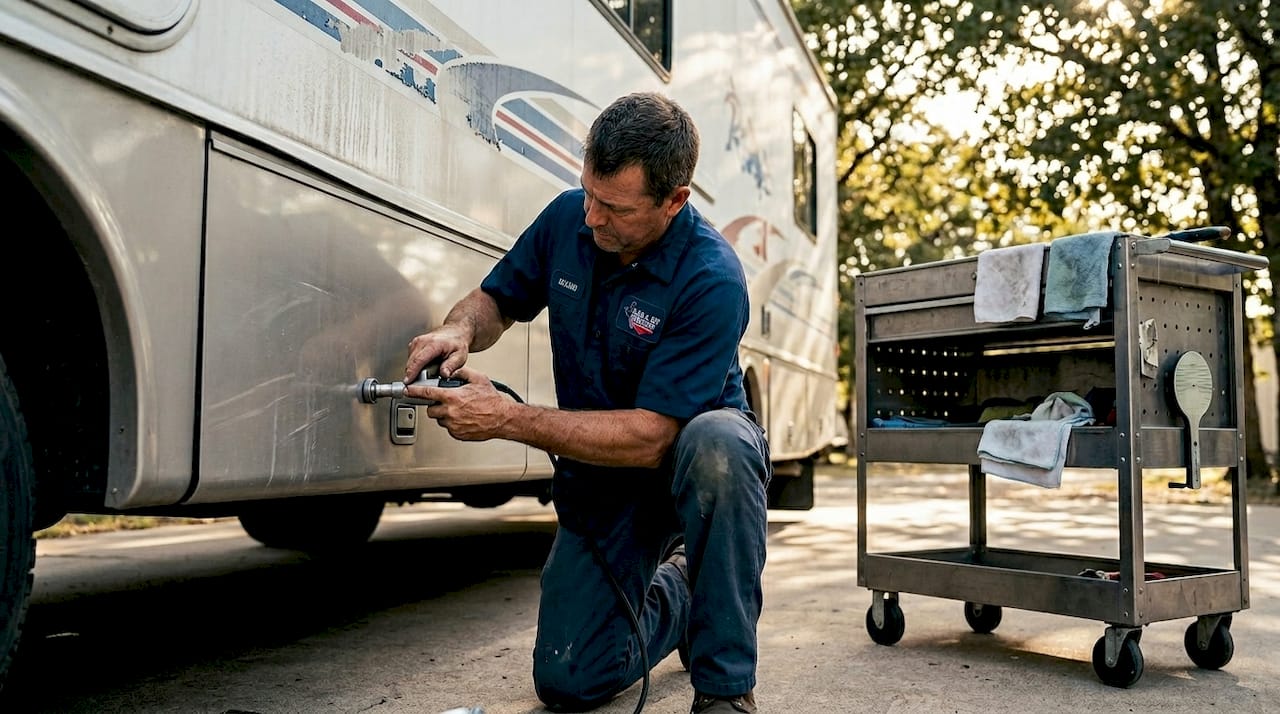
Paintless dent repair, or PDR, is a technique where trained technicians use specialized tools to massage dents out from behind a panel without touching the factory paint. No filler, no repainting, no waiting days for coats to cure. For RVs hit by hail, this is often the single most cost-effective repair option available.
PDR for hail dents costs 50-70% less compared to traditional body shop repairs, making it an especially smart choice for aluminum-sided RVs common throughout Central Texas. That’s not a minor difference. On a repair that would otherwise run $2,000 through conventional methods, PDR might bring it down to $600-$1,000.
| Repair method | Average cost per panel | Paint preserved? | Turnaround time |
|---|---|---|---|
| Traditional body repair | $400 to $800 | No | 3-7 days |
| Paintless dent repair | $150 to $350 | Yes | 1-2 days |
| DIY dent puller kit | $20 to $80 | Varies | Hours |
PDR works best under these conditions:
- Aluminum exterior panels with shallow, round dents (typical hail impact)
- Factory paint is intact with no cracking or flaking around the dent
- Dent depth is less than half its width, meaning it hasn’t creased sharply
- The panel behind the dent is accessible for tool placement
It does not work for torn metal, deep creases, or impact points where paint has already split. Understanding these limitations helps you know when to ask for PDR and when to accept that traditional repair is necessary.
Central Texas hailstorms can affect dozens of RVs at once, which means scheduling at a shop that already handles volume efficiently matters. Explore your hail damage repair options early in the season before shops fill up. And while you’re addressing dents, pairing PDR with a full roof reseal is a smart move, since hail impacts can loosen previously sealed seams even without visible punctures.
“The factory finish on your RV is one of its most valuable protective assets. Preserving it through PDR rather than repainting isn’t just a cost-saver — it’s a quality decision.”
Pro Tip: After any hail event, walk your entire roof perimeter and check every lap joint and vent seal before scheduling bodywork. Water intrusion from a loose seam will cost far more to repair than any dent. Review the RV bodywork DIY guide for a clear inspection checklist.
DIY vs. professional repair strategies: What really saves money?
After considering PDR, the next budget question is who should perform each repair — do it yourself, or pay for professional help?
The honest answer is that neither approach wins across the board. The right answer depends entirely on the type of damage, your skill level, and how much the mistake would cost you if something went wrong.
| Task | DIY cost range | Pro cost range | Risk of DIY error |
|---|---|---|---|
| Minor caulk and sealant work | $15 to $50 | $100 to $200 | Low |
| Fiberglass scratch repair | $40 to $120 | $300 to $600 | Medium |
| Paintless dent repair | $20 to $80 (kit) | $150 to $350 | High without training |
| Collision panel replacement | Not recommended | $800 to $3,000+ | Very high |
| Full exterior repaint | $200 to $500 | $2,000 to $6,000+ | Very high |
DIY makes the most sense for routine maintenance tasks where an error is easy to catch and fix before it causes downstream damage. Resealing lap joints, replacing vent covers, patching minor fiberglass scratches, and applying UV protectant are all reasonable DIY projects for a careful owner.
Professional repairs are worth every dollar when structural integrity, appearance, or resale value are at stake. A poorly executed exterior repaint or misaligned panel replacement can drop your RV’s value by thousands. Check out the breakdown of DIY vs. pro paint repair to see exactly where the trade-offs land for common RV scenarios.
The hybrid approach often delivers the best overall savings. Handle your prep work, like cleaning surfaces, removing trim pieces, and documenting damage with photos, and let professionals handle the actual repair. This saves labor time at the shop rate without risking the quality of the finished work. Learn more about the RV body repair steps that owners can safely handle themselves.
Pro Tip: Keep a running photo log of all damage and repairs. This documentation speeds up insurance claims, supports warranty discussions, and gives future buyers confidence in the vehicle’s history.
Additional ways to save on general RV maintenance
Beyond collision or hail damage, ongoing smart habits and local knowledge keep RV costs low year after year.
Routine maintenance is far cheaper than emergency repair. Here’s a numbered checklist of habits that pay off consistently:
- Inspect and reseal roof seams twice yearly, ideally in spring before storm season and in fall after summer UV exposure.
- Schedule a full system checkup annually covering slide-outs, electrical connections, plumbing, and tires.
- Log every maintenance event with dates, costs, and photos so you can spot patterns and predict failures before they happen.
- Check caulking around windows, vents, and exterior access panels after every road trip longer than 200 miles, since vibration loosens seals faster than most owners expect.
Additional cost-saving habits worth building:
- Store your RV under cover or use a UV-blocking cover during summer months to reduce paint oxidation
- Flush and treat your water lines before seasonal storage to prevent bacterial growth and pipe cracking
- Rotate and inspect tires every 5,000 miles or annually, since RV tires age faster than they wear
- Use Central Texas specialists who understand local risks rather than general auto shops unfamiliar with RV-specific materials
The RV preventative maintenance guide covers seasonal tasks in detail for Hill Country conditions. Pairing those habits with a solid understanding of Central Texas repair costs helps you budget realistically for each year.
Pro Tip: A $150 annual inspection can catch a $40 roof seam failure before it becomes a $4,000 interior water damage repair. That’s the clearest return on investment in all of RV ownership.
What most RV owners get wrong about saving money on repairs
Here’s the honest observation after years of working on rigs across Central Texas: most owners who think they’re saving money are actually just delaying costs.
Choosing the lowest-price shop without asking about repair method or warranty is the most common mistake we see. A cheaper shop that uses inferior filler compounds or skips proper surface prep will send you back within a season. Texas heat, UV radiation, and humidity make substandard repairs fail faster here than almost anywhere else in the country.
Ignoring small damage is equally costly. A dent with a barely visible paint crack looks minor, but Texas summer heat expands that crack. Moisture enters. Aluminum oxidizes. What was a $200 PDR job becomes a $1,500 panel replacement a year later. That’s not a hypothetical scenario, it’s a pattern we see regularly.
The real formula for long-term savings is this: combine cost-effective repair methods like PDR where appropriate, invest in preventative maintenance to avoid emergency repairs, and use local specialists who understand the specific threats your RV faces in Central Texas. That combination keeps quality high while genuinely reducing what you spend over time.
Before your next repair, review the RV emergency repair checklist to make sure you’re not missing critical damage that could escalate.
Save more with local RV repair experts
Knowing your options is only half the equation — executing them with the right team makes the difference between a repair that lasts and one that costs you again in 18 months.

At Class A RV Repairs, we work with RV owners across Central Texas to evaluate damage honestly, explain every available repair method, and help you decide what to tackle now versus what can wait. Our team works directly with insurance companies to streamline claims, and our on-site parts inventory means faster turnaround without inflated ordering costs. Explore our full range of Central Texas RV repair services or use the repair cost guide to plan your next repair budget with accurate local data. We’re here to help you protect your investment without breaking the bank.
Frequently asked questions
What repair method is cheapest for hail damage on an RV in Central Texas?
Paintless dent repair is typically the most affordable option, saving 50-70% compared to traditional repairs on aluminum panels with shallow dents and intact paint.
Can I do my own RV repairs to save money?
DIY works well for routine maintenance tasks like sealing and minor scratch touch-ups, but complex repairs carry real risk of errors that end up costing more to fix professionally.
How do I know if a repair shop is charging a fair price?
Ask for a fully itemized estimate, compare at least two quotes, and cross-reference local rate ranges using an online cost calculator before agreeing to any work.
What is the best way to protect my RV from storm damage?
Inspecting and resealing your roof seams twice yearly and scheduling a full checkup before storm season are the two most effective preventative steps for Central Texas conditions.
Does insurance always cover hail or collision repairs?
Coverage depends on your specific policy. Comprehensive insurance typically includes hail damage, but deductibles, coverage limits, and exclusions vary, so always review your policy details before authorizing repairs.
Recommended
- RV Repair Costs Calculator in Central Texas
- RVs for Sale | Motorhomes, Travel Trailers & Fifth Wheels
- RV repair costs in Central Texas: What owners need to know
- RV repair camping options in Central Texas: 2026 guide
- 50% Off Local Savings | Clipp.com (formerly Local Flavor)
Jean runs growth strategy at AimSetWin, a performance marketing agency specializing in local service businesses across Texas. he's helped plumbers, HVAC companies, pest control operators, and home service brands build predictable revenue systems using data-driven advertising and conversion optimization.


