

Discover essential RV travel safety tips 2026! Ensure your journey is secure with our detailed pre-trip checklist and expert advice.
TL;DR:
- RV travel safety in 2026 emphasizes system inspections, weight management, and adherence to updated standards to prevent breakdowns and hazards. A thorough 30-minute walk-around, electrical and propane checks, and correct weight distribution are essential safety practices before any trip. Ensuring detectors meet current regulations and maintaining situational awareness at stops further enhances road safety in modern RV travel.
RV travel safety in 2026 is defined by a systems approach that covers mechanical integrity, electrical health, load management, and personal security at every stop. The RVIA’s updated 2026 handbook, enforced starting September 1, 2026, raises the bar on what inspections should catch before you leave your driveway. Whether you’re heading through the Texas Hill Country toward Kerrville or pulling a fifth wheel across Central Texas, skipping any one of these systems creates compounding risk. This guide delivers the most current RV travel safety tips for 2026, grounded in NFPA 1192 standards, JACO inspection protocols, and Waggle’s modern monitoring recommendations.
1. RV travel safety tips 2026: start with a 30-minute walk-around
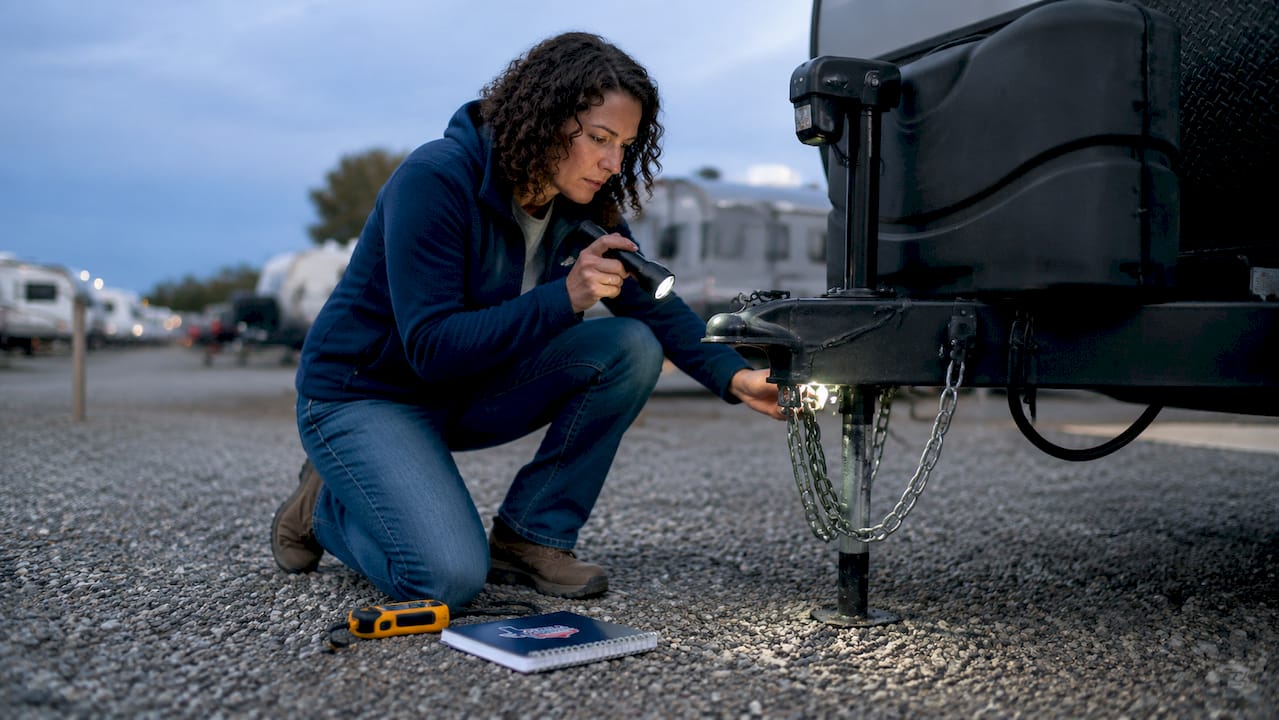
A 30-minute systematic walk-around catches the majority of preventable breakdowns before you ever turn the key. This means checking every tire, every light, the hitch assembly, and all slide-out seals in sequence. Skipping this step is the single most common reason RV owners end up on the shoulder of I-10 outside San Antonio.
Start with tires. TPMS sensors are not a substitute for manual pressure checks with a calibrated gauge, because sensor inaccuracies and storage gaps leave you exposed to blowouts. Check every tire including the spare, and look for sidewall cracking, uneven wear, and tread depth. Trailer tires age out faster than most owners realize, often within five to seven years regardless of tread condition.
Move to the hitch assembly next. Verify the coupler is locked, safety chains are crossed and connected, and the breakaway cable is clipped to the tow vehicle separately from the chains. Check brake lights, turn signals, and running lights before pulling out. Lippert’s checklist recommends a short local practice drive before any long trip to confirm brake controller response and slide-out function under real conditions.
Pro Tip: Re-torque your lug nuts after the first 50 miles of a new trip. Wheels settle under load, and loose lug nuts are a silent failure that a walk-around cannot catch.
2. Electrical and propane system checks you cannot skip
Electrical failures remain a top RV risk and a leading cause of RV fires, which makes battery, converter, and shore power inspection non-negotiable before every trip. The 2026 safety framework treats electrical health as a systems problem, not a one-item checkbox. If you are not sure where to start, the RV electrical troubleshooting guide from Class A RV Repairs walks Texas owners through the most common failure points.
Your pre-trip electrical checklist should cover:
- Battery charge level and terminal corrosion
- Converter and inverter function under load
- All GFCI outlets tested and reset
- Shore power cord and plug condition, no fraying or burn marks
- Waggle or similar remote temperature monitoring active if traveling with pets or medications
Propane safety follows the same logic. Inspect all connections for leaks using soapy water or a dedicated detector, and verify that the regulator is seated and undamaged. Detectors often fail silently past their expiration date, so test your smoke, carbon monoxide, and LP gas detectors using the test button and replace any unit older than five to seven years. The RVIA 2026 handbook and NFPA 1192 now require stricter compliance on detector placement and type, so verify your units meet current standards.
Pro Tip: Write the replacement date on a piece of tape and stick it directly on each detector. You will never have to guess whether it is current again.
3. Weight distribution and cargo securing to prevent trailer sway
Proper weight distribution is the most underestimated safety factor in RV travel. Tongue weight should be 10 to 15 percent of total trailer weight for travel trailers and 15 to 25 percent for fifth wheels. Getting this wrong does not just feel uncomfortable. It creates the conditions for fishtailing, rollover, and loss of control in crosswinds on open Texas highways.
| Trailer type | Recommended tongue weight | Primary risk if incorrect |
|---|---|---|
| Travel trailer | 10 to 15% of total weight | Trailer sway and fishtailing |
| Fifth wheel | 15 to 25% of total weight | Rear axle overload and instability |
Load your heaviest items low and forward of the axle, and distribute weight evenly from left to right. Cargo that shifts during travel changes your tongue weight mid-trip, which is why securing everything inside with straps or non-slip mats matters as much as the initial load. Exterior storage bays are particularly prone to shifting; use cargo nets and check bay latches before departure.
Crosswinds on the stretch between Boerne and Kerrville can push an improperly loaded trailer into the next lane. Correct towing load geometry significantly reduces that hazard, making a weight distribution hitch a practical investment for travel trailers over 6,000 pounds.
4. Personal security and situational awareness at stops
Personal security at RV stops is a practical discipline, not a paranoid habit. Locking your rig, hiding valuables, and using outdoor lighting are the three most effective deterrents against opportunistic theft at campgrounds and rest stops. Texas Hill Country campgrounds are generally safe, but high-traffic stops along US-281 and I-10 corridors attract more risk.
Follow these habits at every stop:
- Lock all doors and compartments before leaving the rig unattended, even briefly
- Keep electronics, cash, and documents out of visible windows
- Use a motion-activated light at the entry door when parked overnight
- Share your location and itinerary with a trusted contact before entering unfamiliar areas
- Park with a clear forward exit so you are not blocked in if you need to leave quickly
- Consider a vehicle security strategy that includes GPS tracking for your tow vehicle
Situational awareness also means knowing your campground layout before dark. Walk the site when you arrive, note the camp host location, and identify the nearest exit. This takes five minutes and removes the guesswork if something goes wrong at 2 a.m.
5. How 2026 RVIA and NFPA standards affect your safety checklist
RVIA began enforcing its 2026 handbook during a June to September transition period, with full enforcement starting September 1, 2026. The updated standards incorporate revised NFPA 1192 and NEC Article 551 requirements, which directly affect propane system design, electrical wiring standards, and detector placement in new and recently manufactured RVs.
What this means for owners in practical terms:
- Verify that your smoke, CO, and LP detectors meet current placement and certification requirements
- Confirm that any electrical modifications made by a previous owner or dealer comply with NEC Article 551
- Check that propane appliances and connections meet NFPA 1192 specifications, particularly if your RV was built between 2020 and 2024 during a transitional manufacturing period
- Request documentation of compliance from your dealer or manufacturer if your RV is new or recently serviced
These 2026 safety code updates also affect insurance claims. If your rig does not meet current standards at the time of an incident, your insurer may dispute coverage. Staying current on compliance protects both your safety and your claim.
Key takeaways
Safe RV travel in 2026 requires combining mechanical pre-trip inspections, electrical and propane verification, correct weight distribution, personal security habits, and compliance with updated RVIA and NFPA 1192 standards.
| Point | Details |
|---|---|
| Pre-trip walk-around | A 30-minute inspection of tires, hitch, lights, and slide-outs prevents most roadside breakdowns. |
| Electrical and propane checks | Test all detectors, inspect shore power connections, and verify propane fittings before every trip. |
| Weight distribution | Keep tongue weight at 10 to 15% for travel trailers and 15 to 25% for fifth wheels to prevent sway. |
| Personal security | Lock all compartments, use motion lighting, and share your itinerary with a trusted contact. |
| Regulatory compliance | Confirm your rig meets 2026 RVIA handbook and NFPA 1192 standards to protect safety and insurance claims. |
What I’ve learned after years of seeing what goes wrong on Texas roads
The rigs that come into our shop after a roadside incident almost always share one thing: the owner skipped something they knew they should have checked. Not because they were careless. Because modern RVs are so comfortable and capable that it is easy to treat them like a car you just get in and drive. They are not.
The most overlooked area I see consistently is the electrical system. Owners check tires and hitches because those feel mechanical and obvious. But a corroded shore power connection or a dead battery bank can strand you just as fast, and it can start a fire faster than either of those. Waggle-style remote monitoring is not a luxury anymore. For anyone traveling through the Hill Country in summer heat, it is a practical tool.
I also want to say plainly: professional inspections before a long trip are worth the cost. Not because you cannot check things yourself, but because a trained eye catches what familiarity hides. When you look at the same rig every week, you stop seeing what has gradually changed. A shop does not have that blind spot.
The pre-trip systems inspection is the single best investment you can make before any trip over 200 miles. Do it before you leave, not after something goes wrong.
— Jean
Keep your RV road-ready with Class A RV Repairs

Class A RV Repairs serves RV owners across San Antonio, Boerne, Kerrville, and the Texas Hill Country from our purpose-built facility in Pipe Creek, TX. Before your next trip, our team can inspect your electrical systems, check propane connections, assess tire and hitch condition, and identify any body or structural issues that could compromise your safety on the road. We work directly with insurance companies and carry a strong supply of parts on-site, which means faster turnaround and less time waiting. If your rig needs attention after a trip or before a long one, contact us for a full RV safety inspection and let us make sure you leave with confidence.
FAQ
What should be on every RV safety checklist?
Every RV safety checklist should cover tires, hitch assembly, brake lights, electrical systems, propane connections, and smoke and CO detectors. RV LIFE recommends both a static visual inspection and a powered-up systems check to catch failures that only appear under operating conditions.
How do I prevent trailer sway on Texas highways?
Keep tongue weight between 10 and 15 percent of total trailer weight for travel trailers, load heavy items low and forward of the axle, and use a weight distribution hitch for trailers over 6,000 pounds. Crosswinds on open Hill Country roads amplify any load imbalance, so correct geometry before you leave.
Do 2026 RVIA standards affect my existing RV?
The 2026 RVIA handbook primarily governs new RV manufacturing, but owners should verify that detectors, propane fittings, and electrical modifications comply with current NFPA 1192 and NEC Article 551 standards. Non-compliance can affect insurance claim outcomes after an incident.
Is TPMS enough to monitor tire pressure on an RV?
TPMS is a useful alert system but not a replacement for manual pressure checks with a calibrated gauge. Sensor inaccuracies and gaps in coverage, especially after storage, mean you should check every tire manually including the spare before each trip.
How often should RV smoke and CO detectors be replaced?
Smoke and carbon monoxide detectors should be replaced every five to seven years, and LP gas detectors every five years. Test each unit with the test button before every trip, and replace any unit that does not respond or has passed its printed expiration date.
Recommended
- RV Systems to Inspect Before Every Trip or Storage
- RV Emergency Repair Checklist: Essential Steps for Quick Fixes
Jean runs growth strategy at AimSetWin, a performance marketing agency specializing in local service businesses across Texas. he's helped plumbers, HVAC companies, pest control operators, and home service brands build predictable revenue systems using data-driven advertising and conversion optimization.


