

Learn how to troubleshoot and prevent RV slide-out problems with practical steps for Central Texas owners, plus when to call a professional repair facility.
TL;DR:
- Most slide-out problems are caused by low battery voltage, debris, or lubrication issues.
- Proper leveling, regular cleaning, and seal inspection can prevent major slide-out failures.
- Professional repair is recommended for structural damage, motor failures, or advanced systems like Schwintek.
When your RV slide-out refuses to budge or grinds to a halt halfway out, it’s easy to assume the worst. But many slide-out problems are far less catastrophic than they first appear. In fact, a large share of failures come down to low battery voltage, debris on the track, or a simple lubrication issue. This guide walks you through the most common slide-out problems, practical troubleshooting steps, and preventative habits that keep your rig road-ready. We’ll also cover when it’s time to hand the job to a professional facility in Central Texas.
Table of Contents
- Understanding RV slide-out systems and common issues
- DIY troubleshooting: What to check before calling a pro
- Preventative care: Avoiding slide-out trouble in the first place
- Special cases: Schwintek slide-outs and other advanced systems
- Expert insights: What most RV owners miss about slide-out repair
- Professional slide-out repair and service in Central Texas
- Frequently asked questions
Key Takeaways
| Point | Details |
|---|---|
| Know common issues | Most RV slide-out problems start with misalignment, motor issues, or power faults. |
| DIY safely first | Owners can check batteries, fuses, and tracks, but major repairs need professionals. |
| Prevent with routine care | Seasonal cleaning, proper leveling, and correct lubricant use keep slide-outs trouble-free. |
| Facility shops matter | For complex systems or repeated failures, expert diagnostic tools ensure long-lasting repair. |
Understanding RV slide-out systems and common issues
Slide-outs add living space to your RV, but they’re also one of the more mechanically complex systems on board. Understanding how they work makes it much easier to spot problems early and describe them accurately when talking to a repair tech.
There are three main types of slide-out systems:
- Manual slide-outs: Operated by hand with a crank mechanism. Rare on modern rigs but still found on older travel trailers.
- Electric slide-outs: Powered by a 12V DC motor connected to a rack-and-pinion or cable system. The most common type on Class A and Class C motorhomes.
- Hydraulic slide-outs: Use fluid pressure from a pump to extend and retract. Found on heavier, full-size motorhomes and fifth wheels.
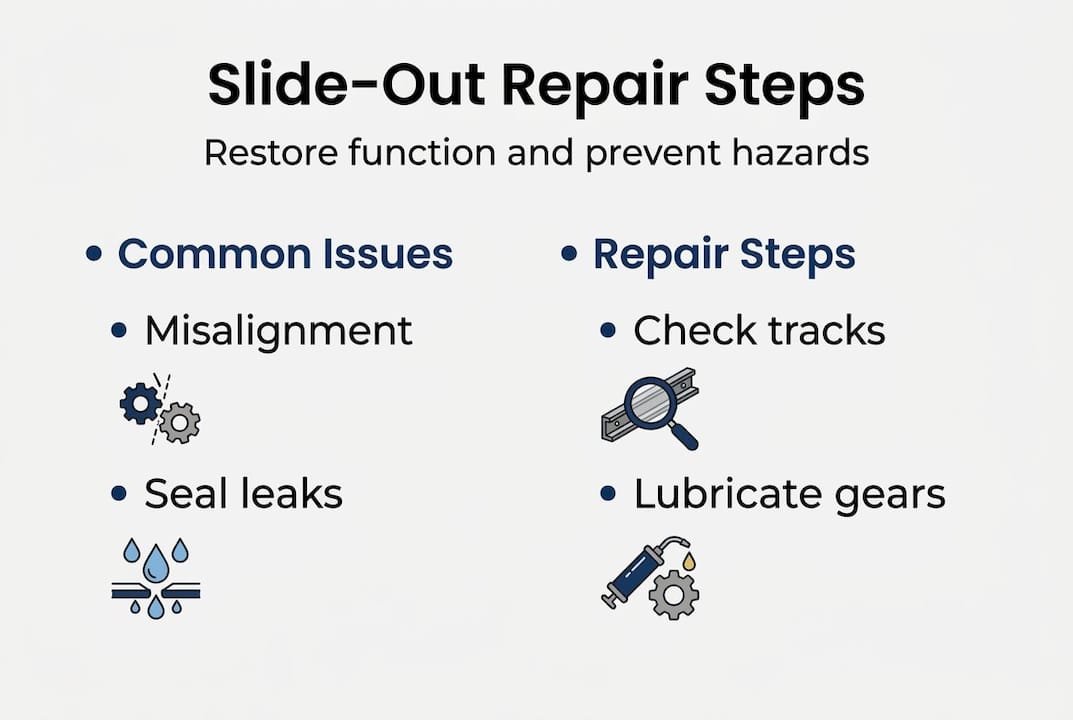
Each type has its own failure points, but the five most common issues across all systems are misalignment, motor or gear failure, electrical faults, track damage, and seal leaks. Misalignment is especially tricky because it often traces back to something as simple as parking on uneven ground. When your RV isn’t level, the slide-out frame binds against the opening, causing stress on motors and gears over time.
| Issue | Likely cause | Urgency |
|---|---|---|
| Misalignment | Uneven parking surface | High |
| Motor or gear failure | Wear, overload, or low voltage | High |
| Electrical fault | Blown fuse or bad wiring | Medium |
| Track damage | Debris, corrosion, or impact | Medium |
| Seal leaks | Age, UV exposure, improper lube | Low to medium |
A seal leak might seem minor, but water intrusion can damage walls, flooring, and electrical systems fast. One malfunctioning slide-out can make your RV unsafe to tow and uncomfortable to live in. For a closer look at slide-out repair steps, our detailed resource covers the full process from diagnosis to fix.
DIY troubleshooting: What to check before calling a pro
Before you call a repair shop, there are several checks you can do yourself. Many slide-out issues are resolved in under an hour with basic tools and a careful eye.
- Check battery voltage first. A healthy 12V battery should read 12.6 volts or higher. Low voltage is the number one cause of sluggish or non-responsive slide-outs. Charge or replace the battery before anything else.
- Inspect fuses and breakers. Locate your RV’s fuse panel and look for any blown fuses tied to the slide-out circuit. Reset tripped breakers and replace fuses if needed.
- Clear the track. Walk around the slide-out and remove any leaves, dirt, or gravel sitting on the track. Even a small rock can jam the mechanism.
- Do a visual wiring check. Look for pinched, frayed, or disconnected wires near the motor and control switch. Rodent damage is more common than most owners expect.
- Lubricate the track and gear. Use dry silicone spray only. Never use WD-40 or any petroleum-based product on slide-out tracks or seals.
- Resync the motors. Some electric systems allow a motor resync through the control panel. Check your owner’s manual for the specific procedure.
“Always start with the simplest fix. Most slide-out calls we see could have been caught at the battery or fuse stage.”
Pro Tip: Keep a can of dry silicone spray in your RV toolkit. A quick application every few months on the tracks prevents binding and extends gear life significantly. For broader upkeep, our trailer maintenance tips and DIY RV repair guide are solid starting points.
Stop DIY work and call a professional if the motor makes grinding sounds, the slide moves unevenly on both sides, or you see structural damage to the frame or gear teeth.
Preventative care: Avoiding slide-out trouble in the first place
The best slide-out repair is the one you never need. A few consistent habits dramatically reduce the chances of a breakdown on the road or at your campsite.
- Level your RV every single time you park. This is the single most impactful habit. Leveling prevents misalignment and reduces stress on motors, gears, and the slide frame itself.
- Clean tracks seasonally. Dirt and grit act like sandpaper on your gear system. Wipe tracks with a damp cloth, let them dry, and apply dry silicone spray.
- Inspect seals twice a year. Look for cracks, gaps, or areas where the seal pulls away from the slide edge. Damaged seals let in water and bugs.
- Maintain a full battery. Keep your house batteries charged above 12.4 volts when in storage. A weak battery strains the motor every time you operate the slide.
- Avoid petroleum-based lubricants. Products like WD-40 break down rubber seals and attract grime. Silicone-based products are safe and effective.
Pro Tip: Take photos of your slide-out seals and track condition at the start of each season. Comparing year-over-year photos makes it easy to catch gradual wear before it becomes a real problem.
For a full seasonal checklist, our RV maintenance checklist and preventative maintenance tips give Central Texas owners a structured approach built around local conditions like heat, humidity, and Hill Country dust.
Special cases: Schwintek slide-outs and other advanced systems
Not all slide-outs are created equal. Newer and luxury RV models often use the Schwintek in-wall slide system, which operates differently from traditional rack-and-pinion designs and has its own failure patterns.
The Schwintek system uses two motors mounted inside the wall, driving a gear track embedded in the slide frame. It’s a clean design, but sync errors and underpowered motors are the most frequently reported problems. When the two motors fall out of sync, the slide tilts and binds, which can cause significant damage if forced.
| Schwintek issue | Symptom | Recommended action |
|---|---|---|
| Motor sync error | Slide tilts or binds | Resync procedure or motor replacement |
| Underpowered motor | Slow or incomplete travel | Upgrade to Vroom system |
| Gear track wear | Grinding or skipping | Track replacement at a facility |
| Control board failure | No response to switch | Professional diagnostics |
The Vroom upgrade replaces the stock Schwintek motors with higher-torque units and a more reliable control board. Many owners report that a single Vroom upgrade eliminates years of recurring sync problems. This is not a DIY job. The motors are recessed inside the wall cavity and require specific calibration after installation.
“If your Schwintek has failed twice in two years, an upgrade is almost always more cost-effective than a third repair.”
When speaking with a repair provider, ask whether they have experience with in-wall systems specifically. Our replacement guide for advanced parts covers what to expect when sourcing components for Schwintek and similar systems.
Expert insights: What most RV owners miss about slide-out repair
After working on hundreds of RVs across Central Texas, one pattern stands out clearly. Most major slide-out failures didn’t start as major problems. They started as a small noise, a slightly slow retraction, or a seal that looked a little worn. Owners noticed, made a mental note, and kept driving.
DIY troubleshooting is genuinely valuable up to a clear line. That line is structural damage, recurring motor failure, or anything involving the frame. Past that point, a facility with proper diagnostic tools will find the root cause faster and fix it more permanently than any home repair. Ignoring early warning signs of RV trouble almost always turns a $200 fix into a $2,000 one.
Professional slide-out repair and service in Central Texas
If your slide-out still isn’t cooperating or you want peace of mind before your next trip, professional service in Central Texas is the most reliable next step.

At Class A RV Repairs, we work on all slide-out types including Schwintek, hydraulic, and electric rack systems across motorhomes, travel trailers, and fifth wheels. Our purpose-built facility keeps common parts on-site so repairs move quickly. We also offer on-site camping while your rig is being serviced. Explore our full RV repair services or review our repair costs overview to plan your visit with confidence.
Frequently asked questions
How can I tell if my RV slide-out motor is failing?
You may hear clicking or grinding, notice slow movement, or the slide stops partway. Unusual noise and intermittent movement are the clearest early signs, so check battery voltage and fuses before assuming the motor itself is the problem.
Why shouldn’t I use WD-40 on my slide-out tracks?
WD-40 and other petroleum-based products attract dirt and degrade rubber seals over time. Dry silicone spray is the correct lubricant for slide-out tracks and mechanisms.
What’s the most important step for preventing slide-out problems?
Always make sure your RV is fully level before operating the slide-out. Leveling prevents misalignment, which is one of the top causes of motor and gear failure.
Can I fix a slide-out electrical issue myself?
Many electrical issues are resolved by checking battery charge and fuses first. Complex wiring problems or recurring electrical faults need a professional diagnosis to avoid repeat failures.
Recommended
- RV slide-out repair guide for Central Texas owners
- RV bodywork repair tutorial: DIY steps for lasting results
- Signs your RV needs repair: top warning flags for 2026
- Essential RV parts replacement guide: Central Texas owners
Jean runs growth strategy at AimSetWin, a performance marketing agency specializing in local service businesses across Texas. he's helped plumbers, HVAC companies, pest control operators, and home service brands build predictable revenue systems using data-driven advertising and conversion optimization.


