

Discover the RV repair trends in 2026 that Texas owners must know. Learn how rising costs and new tech can save you money on repairs!
TL;DR:
- RV repair costs in 2026 are rising due to higher labor rates and increased wait times at dealerships, prompting owners to consider mobile services and scheduling earlier. The growth of certified technicians improves diagnostic accuracy and insurance claims, while preventative maintenance and advanced materials extend RV lifespan and reduce costly repairs. Smart scheduling, certification verification, and modernization of roofing and diagnostic tools are key to managing repairs efficiently in 2026.
RV repair trends in 2026 are defined by three forces reshaping how owners manage their rigs: labor rates rising to $150–$170 per hour at dealerships, a growing pool of certified technicians improving service quality nationwide, and a fast-expanding mobile repair sector that bypasses traditional service bottlenecks. For RV owners in Central Texas and the Hill Country, understanding these shifts is the difference between a $300 repair and a $3,000 emergency. This guide breaks down what is actually changing in 2026 and how to use those changes to your advantage.
What are the current RV labor costs and wait time challenges in 2026?
Dealership labor rates now average $150 to $170 per hour nationally, a figure that reflects both technician shortages and rising shop overhead. That rate means a two-hour slide-out adjustment can cost $300 before parts. For owners near San Antonio or Kerrville, that adds up fast when a repair requires multiple service visits.
Wait times compound the cost problem. During spring and summer peak seasons, service bays at major dealerships are booked weeks out. An RV sitting in a queue for three weeks is an RV you cannot use, and in Texas heat, deferred repairs on roof seals or AC units tend to escalate quickly.
The owners who manage this best share a few habits:
- Book service appointments in late February or October to avoid the spring and fall rush
- Get a written estimate before authorizing any work, since hourly billing adds up fast at these rates
- Ask specifically whether the technician assigned is certified, since certification directly affects diagnostic accuracy and repair speed
- Consider mobile repair providers for jobs that do not require a full service bay
Pro Tip: Schedule non-emergency repairs for early spring or fall in the Texas Hill Country. Shops like Class A RV Repairs in Pipe Creek, TX see significantly shorter lead times outside peak season, which means faster turnaround and more scheduling flexibility for you.
How is the growth of certified technicians influencing RV repair services?
The certified technician workforce surpassed 7,500 professionals nationwide by the end of 2025, with more than 1,000 dealerships now employing certified staff. That number matters because certification through the RVTI (RV Technical Institute) sets a defined competency standard across electrical, plumbing, propane, and structural systems. An owner dealing with a certified tech is far less likely to get a misdiagnosis that turns a $400 fix into a $1,500 one.
The growth in certified staff is improving service capacity, but it has not eliminated the biggest bottleneck in the industry. Manufacturer warranty approvals add 5 to 7 days to repair timelines independent of technician skill or availability. That delay is a structural problem with OEM processes, not a reflection of shop quality.
Here is how certified versus non-certified service compares in practice:
| Factor | Certified technician | Non-certified technician |
|---|---|---|
| Diagnostic accuracy | Trained across all major RV systems | Varies widely by experience |
| Warranty claim eligibility | Typically required by manufacturers | Often disqualifies warranty claims |
| Repair speed | Faster due to standardized training | Slower on unfamiliar systems |
| Insurance documentation | Meets insurer standards | May not satisfy claim requirements |
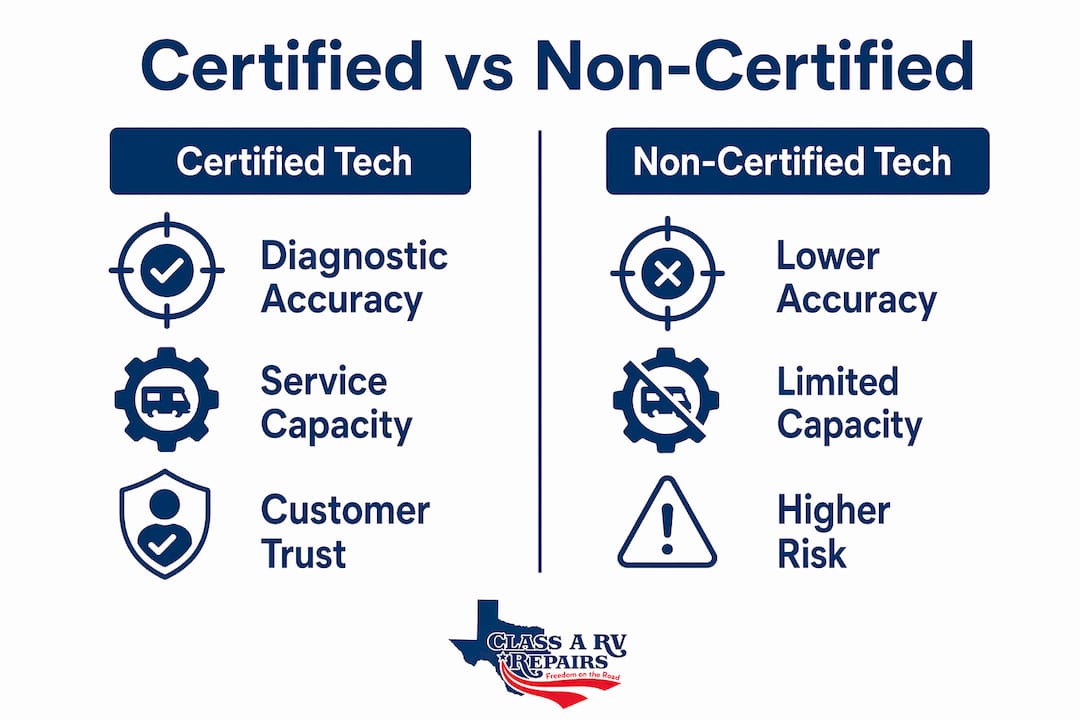
Pro Tip: Always ask for the technician’s RVTI certification number before authorizing work. Shops that employ certified techs can also process insurance claims more efficiently, which matters if your repair involves collision or weather damage.
Why is mobile RV repair gaining popularity among owners in 2026?
Mobile repair is faster, cheaper, and less disruptive than dealership service for a wide range of common issues. No towing fees, no weeks-long waitlists, and the tech comes to your site whether you are parked in Boerne, Comfort, or a Hill Country campground. For full-time RVers and snowbirds who cannot afford extended downtime, this model is a practical solution.

Mobile techs also bypass the OEM approval bottleneck that stalls dealership repairs. For non-warranty work and many minor repairs, a certified mobile technician can diagnose and fix the problem the same day. That speed advantage is why mobile RV repair demand has grown sharply in 2026.
Common repairs handled effectively by mobile providers include:
- Electrical troubleshooting and outlet or converter failures
- Fresh water and gray water plumbing leaks
- Roof reseals and minor membrane repairs
- Slide-out lubrication, realignment, and motor replacements
- Appliance diagnostics for refrigerators, water heaters, and furnaces
The key is vetting providers carefully. Not every mobile tech carries RVTI certification, and an uncertified repair on a propane system or roof membrane can create safety and insurance problems. Check certifications, read reviews, and ask for itemized quotes before any work begins.
What preventative maintenance strategies reduce costly repairs in 2026?
Ninety percent of expensive emergency repairs are avoidable with consistent seasonal maintenance. That statistic reflects a simple reality: most catastrophic RV failures start as small, detectable problems that owners defer too long. A $50 roof reseal done in March prevents a $900 water damage repair in July.
For Texas Hill Country owners, the seasonal maintenance calendar should account for the region’s heat, UV exposure, and occasional freeze events. A preventative maintenance plan built around those conditions will catch the issues most likely to cause problems here.
The table below shows the most common 2026 RV repairs, their typical cost ranges, and the maintenance step that prevents each one:
| Repair type | Typical cost range | Prevention step |
|---|---|---|
| Roof leak repair | $300 to $1,200 | Inspect and reseal roof seams twice per year |
| Slide-out repair | $400 to $1,500 | Lubricate slide rails and seals every 3 months |
| Refrigerator repair | $200 to $800 | Clean coils and check door seals seasonally |
| Water heater replacement | $250 to $700 | Flush the tank annually and inspect the anode rod |
| Tire blowout damage | $500 to $2,000+ | Monitor tire pressure before every trip |
Full-time RVers benefit most from treating maintenance as a fixed monthly expense. Experienced full-timers budget around $300 per month for repairs and upkeep, which smooths out the financial impact of both routine service and unexpected failures. That approach prevents the financial shock of a $1,500 repair hitting all at once.
Pro Tip: Keep a digital maintenance log with dates, costs, and photos of every repair. This record speeds up diagnostics at your next service visit and adds documented value when you sell the rig.
What new technologies and materials are shaping RV repair in 2026?
The biggest material shift in 2026 RV repairs is the move toward commercial-grade 45-mil TPO and EPDM roofing membranes. These materials carry long-term warranties and eliminate the annual caulking cycle that most RV owners dread. The upfront cost runs $4,000 to $12,000 depending on roof size, but the long-term savings over repeated patch repairs are significant.
Beyond roofing, several other technologies are becoming standard practice in 2026:
- Tire pressure monitoring systems (TPMS) are now expected on any well-maintained rig, reducing blowout risk on Texas highways
- Digital maintenance logs improve diagnostic speed and increase resale value by giving buyers a verified service history
- Advanced slide-out diagnostic tools allow technicians to identify motor and seal failures faster, reducing labor time and repair costs
- Thermal imaging cameras are entering more professional shops, enabling non-invasive detection of roof leaks and electrical hot spots before they cause visible damage
These tools and materials do not replace skilled technicians. They make skilled technicians faster and more accurate, which is why the shops investing in them are delivering better outcomes than those relying on older methods.
Key takeaways
The most effective approach to 2026 RV repairs combines certified professional service, proactive seasonal maintenance, and smart scheduling to control costs and minimize downtime.
| Point | Details |
|---|---|
| Labor rates are rising | Dealership rates of $150 to $170 per hour make early scheduling and certified techs worth prioritizing. |
| Certified techs improve outcomes | RVTI-certified technicians deliver faster diagnostics and qualify repairs for insurance and warranty claims. |
| Mobile repair fills service gaps | Mobile techs bypass OEM approval delays and eliminate towing costs for most common repairs. |
| Preventative maintenance pays off | Ninety percent of emergency repairs are avoidable with consistent seasonal inspections and upkeep. |
| New materials extend roof life | Commercial-grade TPO and EPDM membranes replace repeated patch cycles with decades of leak protection. |
What I have seen in Central Texas shops this year
The labor rate and wait time conversation is real, and I see its impact on Hill Country RV owners every week. Owners who called a dealership in March and got a June appointment are the ones showing up here frustrated and sometimes with damage that has worsened while they waited. That pattern is not going away in 2026.
What I have found actually works is a combination of two things: getting on a certified shop’s schedule before you need emergency service, and treating your maintenance calendar like a bill that is due whether or not something is broken. The owners who do both almost never face the $1,500 surprise repairs. The ones who skip seasonal inspections and chase the cheapest quote end up paying more over three years than the owners who spent a little more on quality service upfront.
The technology side is genuinely exciting. Thermal imaging and digital logs are changing how fast we can diagnose problems, and the shift to commercial-grade roofing materials means fewer repeat customers coming back for the same leak. That is good for owners and good for shops that care about doing the job right the first time.
— Jean
How Class A RV Repairs serves Central Texas owners in 2026
Class A RV Repairs in Pipe Creek, TX is a full-service RV repair center built specifically for the repair demands facing Hill Country and San Antonio area owners in 2026. The shop handles collision repair, fiberglass work, roof replacement, slide-out service, and mechanical repairs across motorhomes, travel trailers, and fifth wheels.

The facility carries an on-site parts inventory that reduces wait times, and the team works directly with insurance companies to simplify claim processing. For owners who cannot leave their rig, on-site camping accommodations are available during repairs. Whether you need a roof membrane replacement, a slide-out diagnosis, or a full collision repair estimate, the RV repair services at Class A RV Repairs are designed to get you back on the road faster. Contact the shop today to schedule your 2026 service appointment before peak season fills the calendar.
FAQ
What are average RV repair labor rates in 2026?
Dealership labor rates average $150 to $170 per hour nationally in 2026. Independent certified shops and mobile technicians often charge less while delivering comparable or faster service.
How can I avoid long RV repair wait times?
Schedule service in late winter or early fall to avoid the spring and summer backlog. Mobile repair providers also offer faster turnaround for most non-structural repairs.
Is mobile RV repair as reliable as dealership service?
Mobile repair is reliable for most common issues including electrical, plumbing, roof reseals, and slide-out work when the technician holds RVTI certification. Always verify credentials and request an itemized estimate before authorizing repairs.
What RV repairs are most preventable with maintenance?
Roof leaks, slide-out failures, and water heater breakdowns are among the most common and most preventable repairs. Seasonal inspections and early warning signs caught early keep repair costs well below emergency rates.
How much should I budget monthly for RV repairs?
Experienced full-time RVers budget around $300 per month to cover routine, seasonal, and unexpected repairs. Part-time owners can budget less but should maintain a dedicated repair reserve to avoid financial disruption from larger jobs.
Recommended
- RV Blogs & Tips | Read Repairs & Maintenance Guides
- RV Service Tips for Texas Owners: 2026 Guide
- RV Repair Warranties: What Central Texas Owners Need
- RV service centers in Texas: what owners need to know
Jean runs growth strategy at AimSetWin, a performance marketing agency specializing in local service businesses across Texas. he's helped plumbers, HVAC companies, pest control operators, and home service brands build predictable revenue systems using data-driven advertising and conversion optimization.


