

Master the industry terms for RV repairs to enhance communication, avoid costly mistakes, and make informed decisions at repair shops.
TL;DR:
- Understanding key RV repair terminology helps owners communicate effectively, preventing misread estimates and claim issues. Certified technicians use standardized language to accurately diagnose problems, ensuring proper repairs and warranty protection. Knowledge of repair categories, systems, and insurance terms enables owners to make informed decisions and avoid costly misunderstandings.
Walking into an RV repair shop without knowing the industry terms for RV repairs is like going to a doctor’s appointment without speaking the language. You leave nodding, but you have no idea what actually happened or what you agreed to. For RV owners in Central Texas and the Hill Country, this language gap causes real problems: misread estimates, botched insurance claims, and repairs that miss the actual problem. This guide decodes the most important RV repair terminology so you can walk into any shop, talk to any adjuster, and know exactly what’s being discussed.
Table of Contents
- Key takeaways
- Core industry terms for RV repairs by service type
- Technical terms for RV systems that drive repair scope
- Diagnostic and process terms used by certified repair shops
- Why knowing the language helps during Texas insurance claims
- My take on terminology and what it means for repairs in Central Texas
- Get expert RV service from a shop that explains everything
- FAQ
Key takeaways
| Point | Details |
|---|---|
| Terminology gaps cost money | Not understanding common RV repair terms leads to misread estimates, wrong parts, and claim denials. |
| Certification matters | RVTI certified technicians cover seven systems and use standardized language that protects your warranty. |
| Diagnosis comes first | A proper diagnosis prevents unnecessary parts replacement and keeps repair costs accurate. |
| OEM vs aftermarket is a real choice | Using non-OEM parts can void your warranty and complicate insurance claims in Texas. |
| Asking questions is your right | Shops should explain every term on an estimate clearly. If they won’t, that’s a red flag. |
Core industry terms for RV repairs by service type
Before any technician touches your rig, they’ll categorize the work. Knowing these categories helps you confirm that the shop is addressing the right problem.
Collision repair covers structural and cosmetic damage from impact events. This includes frame straightening, panel replacement, and paint restoration after a crash or contact with an overhead obstacle. Many Texas RV owners encounter this after low clearance collisions at gas stations or campground entrances.
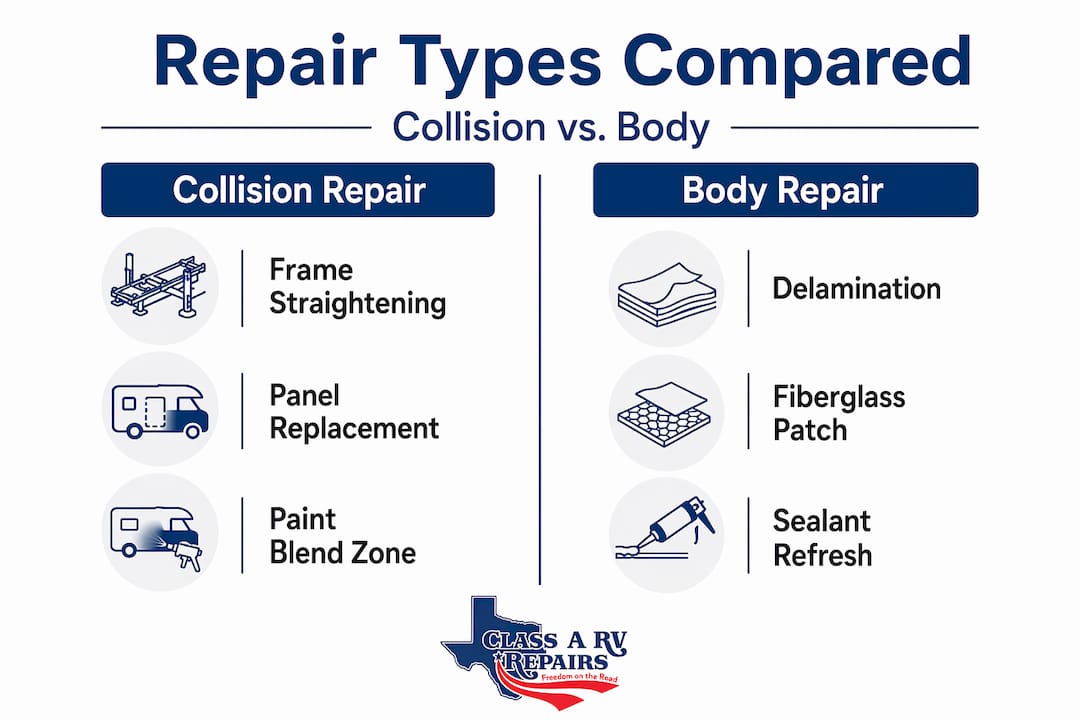
Body repair is broader. It includes dents, tears, delamination (when the outer wall separates from the interior substrate), and stress cracks. Body repair and collision repair overlap, but body repair also includes non-impact damage from weather, road debris, or UV degradation common across Central Texas summers.
Paint repair involves more than color matching. Shops refer to blend zones, which are adjacent panels painted to feather the new color into the existing finish so repairs are invisible. Proper paint repair process requires matching texture, sheen, and UV fading, not just color codes.
Fiberglass repair uses resin, mat, and filler materials to restore structural integrity to damaged panels. When you see the term gelcoat, that’s the protective outer layer of fiberglass. Cracking gelcoat left unaddressed allows moisture intrusion.
Roof repair terminology includes EPDM (a rubber membrane), TPO (thermoplastic polyolefin), and lap sealant. These are the materials that keep water out. When a shop mentions resealing, they’re applying fresh sealant around vents, skylights, and seams that have dried and cracked.
Slide-out repair is its own discipline. Slide-out issues often result from inadequate voltage, binding, or lubrication problems rather than motor failure. Shops use terms like rack and pinion, worm gear, and room seal when diagnosing these systems.
Pro Tip: When you get an estimate, ask the shop to label each line item by repair category. This makes comparing estimates across shops straightforward and helps your insurance adjuster review the claim faster.
Technical terms for RV systems that drive repair scope
Most RV repair conversations eventually land on systems, because system failures often cause or complicate physical damage. RVTI certified technicians are trained across seven major systems: propane, electrical, plumbing, appliances, body, generator, and chassis. Here’s the vocabulary from each that you’ll hear most often.
Electrical system terms:
- GFCI (Ground Fault Circuit Interrupter): A safety outlet that trips when it detects current leakage. Not the same as a tripped breaker.
- Converter: Converts shore power (120V AC) to 12V DC to charge batteries and run DC appliances.
- Battery voltage: The charge level in your house batteries. 90% of electrical issues in RVs can be traced to battery voltage, fuse panels, or GFCI outlets before any parts need replacing.
- Inverter: Converts battery power back to 120V AC for running appliances off-grid.
Plumbing system terms:
- Accumulator tank: A small pressurized tank that smooths water pump cycling. When it fails, your pump short-cycles constantly.
- Short-cycling: The pump turning on and off rapidly, which often signals air in the lines, a failed accumulator, or a leak rather than pump failure itself.
- Winterization: The process of purging water lines with compressed air or RV antifreeze to prevent freeze damage.
Propane system terms:
- Auto-changeover regulator: Automatically switches from the empty tank to the full tank. The red indicator light means your primary tank is depleted. It does not mean the regulator has failed, though many owners mistake it for a malfunction.
- Two-stage regulator: Reduces high tank pressure to usable appliance pressure in two steps for safer, consistent flow.
Chassis and generator terms:
- Chassis: The structural frame and drivetrain components of a motorhome. Chassis service is distinct from body repair.
- Generator load: How much electrical demand is placed on the generator. Overloading causes shutdowns that get misread as mechanical failure.
Pro Tip: When describing a problem to a technician, say what the system was doing, not just what failed. “My pump runs for two seconds, stops, and repeats” gives a technician much more to work with than “my water pump is broken.”
Diagnostic and process terms used by certified repair shops
These are the terms that show up on your paperwork and in conversations with insurance adjusters. Understanding them protects you.
- Diagnosis: The systematic process of identifying root cause before recommending repairs. A shop that skips diagnosis and jumps to parts replacement is guessing on your dime.
- Warranty repair: Work covered under the manufacturer’s warranty. Most RV warranty repairs require technicians to follow exact OEM diagnostic and repair standards or the claim gets denied.
- OEM parts: Original Equipment Manufacturer parts made to factory specification. Aftermarket parts are alternatives that may fit but may not meet the same standards. Your warranty usually requires OEM.
- Estimate: A written breakdown of anticipated labor and parts costs. Always get it in writing before authorizing work.
- Throughput: How many repairs a shop can complete in a given timeframe. Repair throughput is about process efficiency, not just technician count. Shops with clear processes complete repairs faster and with fewer errors.
- Deductible: The amount you pay out of pocket before insurance covers the rest. In RV collision claims, this applies per incident.
| Term | What it means for you |
|---|---|
| OEM parts | Protects your warranty; required by most insurers |
| Aftermarket parts | Lower cost but may void warranty or complicate claims |
| Diagnosis fee | Often applied toward repair cost if you authorize work |
| Supplement | A revised estimate submitted to insurance when hidden damage is found after teardown |
Why knowing the language helps during Texas insurance claims
There’s a direct line between vocabulary and money when it comes to RV insurance claims. Adjusters use specific language, and if you can speak it back, you get faster decisions and fewer denials.
Here are the situations where terminology knowledge pays off:
- Supplement requests: When a shop finds additional damage after teardown, they file a supplement with your insurer. Knowing what this is prevents you from thinking the shop is inflating costs after the fact.
- Total loss threshold: Some insurers declare an RV a total loss when repair costs exceed a percentage of its value, typically around 70 to 80 percent. Knowing this term helps you understand why an adjuster might push for replacement over repair.
- Documented repair standards: Certified technicians provide documentation that meets manufacturer protocols. This matters when warranty work is disputed.
For Texas Hill Country owners specifically, understanding RV maintenance standards relevant to local climate, road conditions, and seasonal use helps you frame discussions with both adjusters and shops. UV damage and thermal cycling from Texas heat accelerate wear that adjusters sometimes misclassify as owner neglect.
Pro Tip: Before calling your insurer after an incident, write down your own description of the damage using repair categories: body, roof, slide-out, electrical. Adjusters respond better to organized, specific descriptions than to general statements like “the whole side is messed up.”
My take on terminology and what it means for repairs in Central Texas
I’ve been working on RVs in Central Texas long enough to know that the most expensive repairs aren’t always the ones with the most physical damage. They’re the ones where nobody communicated clearly from the start. I’ve seen owners approve work they didn’t understand, only to dispute it after the fact. I’ve seen insurance claims stall for weeks because an owner couldn’t explain what happened in terms the adjuster could process.

What I’ve learned is that a few minutes of explanation up front, going through what the terms on an estimate actually mean, cuts the confusion that causes 80 percent of repair delays. When I walk an owner through why we’re recommending a diagnosis before replacing a slide-out motor, and explain that binding and voltage issues are more common causes than motor failure, they understand why we’re not just swapping parts. That conversation saves them money and earns their trust.
My honest advice: if a shop won’t take ten minutes to explain their estimate in plain language, find one that will. You deserve to understand exactly what’s being done to your RV and why.
— Jean
Get expert RV service from a shop that explains everything
At Classarvrepairs in Pipe Creek, TX, we work with RV owners from San Antonio, Boerne, Kerrville, and across the Texas Hill Country who want more than just repairs. They want to understand what happened and why. Our certified technicians handle collision repair, fiberglass work, roof restoration, slide-out service, and paint, and they document everything in language both you and your insurer can follow. We work directly with insurance companies and handle supplement filings. Explore our full RV repair services or reach out to schedule a consultation. We also offer on-site camping accommodations for clients waiting for repairs, so your trip doesn’t have to stop just because your rig does.
FAQ
What are the most common industry terms for RV repairs?
The most commonly used terms include collision repair, body repair, delamination, gelcoat, EPDM roofing, OEM parts, diagnosis, and throughput. Understanding these helps you communicate clearly with shops and insurance adjusters.
What does “OEM parts” mean in RV repair?
OEM stands for Original Equipment Manufacturer. These are parts made to the exact factory specification for your RV. Most manufacturer warranties and insurance claims require OEM parts to remain valid.
Why does diagnosis matter before RV repairs begin?
A proper diagnosis identifies the root cause of a problem rather than replacing parts based on symptoms. Skipping this step leads to repeat failures and higher costs. Certified technicians use diagnosis to confirm the actual issue before any work begins.
What is a repair supplement in an RV insurance claim?
A supplement is a revised repair estimate submitted to your insurer after teardown reveals damage that wasn’t visible during the initial inspection. It’s a normal part of the collision repair process, not an attempt to inflate costs.
How do industry standards in RV repair affect my warranty?
Following manufacturer repair standards is required for warranty work to remain valid. Shops that use non-OEM parts or skip documented procedures risk voiding your coverage, even for repairs that appear correct.
Recommended
- RV service center terms every Texas owner should know
- RV service centers in Texas: what owners need to know
- RV Repair Warranties: What Central Texas Owners Need
- RV repair costs in Central Texas: What owners need to know
Jean runs growth strategy at AimSetWin, a performance marketing agency specializing in local service businesses across Texas. he's helped plumbers, HVAC companies, pest control operators, and home service brands build predictable revenue systems using data-driven advertising and conversion optimization.


